
Tons to Cubic Yards Converter
Order tip: suppliers weigh material on a scale, so your delivered amount is exact in tons — but spread coverage is planned in yards. Convert before you order, and add 5–10% for compaction and spillage.
More Calculators
Cubic Yard CalculatorDirt CalculatorConcrete CalculatorGravel CalculatorSand CalculatorMulch CalculatorStone CalculatorTopsoil CalculatorCubic Feet to Cubic YardsA truck or a supplier quote often arrives in tons, while the job is planned in cubic yards. That mismatch is normal: the same material can be sold either way — the yard is a volume and the ton is a weight — and the only thing that links them is how heavy a cubic yard of that material is.
This converter works out the cubic yards from your tonnage and the material you choose. It uses typical densities like gravel at 2,800 lb per cubic yard, and you can set a custom weight if your supplier gives one.
Why Tons and Cubic Yards Change With the Material
A ton is always 2,000 lb, but a cubic yard of material is not always the same weight. Dry sand packs differently from wet soil, so a volume that is one cubic yard can be a lot lighter or heavier depending on the material and how wet it is.
That is why the tons converter asks for a material, not just weights and numbers. The material sets the density — the weight of one cubic yard — which the converter uses to turn your tonnes into yards.
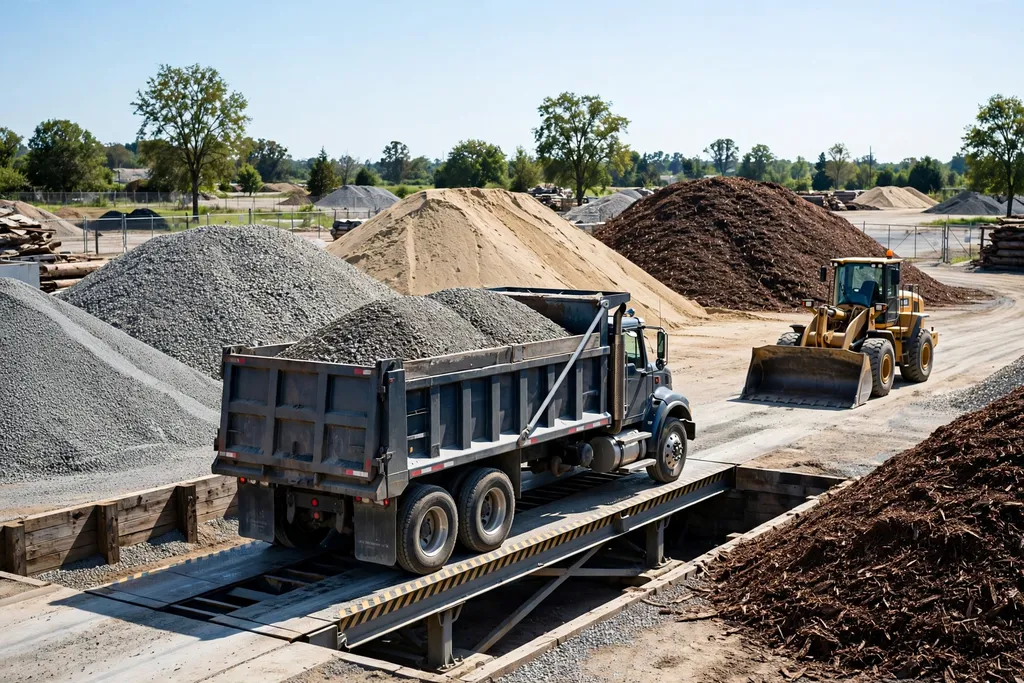
The gravel density is the anchor for this site: a cubic yard of gravel weighs about 2,800 lb — that is 1.4 tons, since one ton is 2,000 lb. Densities vary by material and moisture, so use these numbers as a planning guide and check your supplier if the order is large.
How to Convert Tons to Cubic Yards
The rule is short: divide the weight of one cubic yard by 2,000, then divide tons by the result. The converter does it in one step; the formula behind it is:
- Pick your material to get the weight of one cubic yard.
- Convert that weight to tons: lb per cubic yard ÷ 2,000.
- Divide the tons you have by the tons per cubic yard.
- Round up slightly for spillage and settling.
Cubic yards = tons ÷ (lb per cubic yard ÷ 2,000)
Worked example — gravel at 2,800 lb per cubic yard. Tons per cubic yard = 2,800 ÷ 2,000 = 1.4, so 5 tons = 5 ÷ 1.4 = 3.57 cubic yards. At 27 cubic feet per yard, that is 3.57 × 27 = 96.43 cubic feet — roughly the volume of a 10 ft × 10 ft bed filled 12 inches deep.
Tons to Cubic Yards by Material
Typical densities on this site — the converter uses the same numbers:
| Material | lb per cubic yard | Tons per cubic yard | Cubic yards from 1 ton |
|---|---|---|---|
| Gravel | 2,800 | 1.4 | 0.71 |
| Crushed stone | 2,700 | 1.35 | 0.74 |
| Sand | 2,600 | 1.3 | 0.77 |
| Topsoil | 2,000 | 1.0 | 1.00 |
| Mulch | 400–800 | 0.2–0.4 | 1.25–5.00 |
Those are typical values — check your supplier for exact densities, especially for mixed or wet material.
Cubic Yards to Tons: Going the Other Way
The converter gives cubic yards first, then also shows the estimated weight, so both numbers stay consistent. If you start with a volume and need the weight, the formula is volume × weight of one cubic yard.
Tons = cubic yards × lb per cubic yard ÷ 2,000
Example: 3.57 cubic yards × 2,800 lb ÷ 2,000 = 4.9986 tons — that is 5 tons, as expected.
Frequently Asked Questions
How many cubic yards are in 5 tons of gravel?
3.57 cubic yards. One cubic yard of gravel weighs about 2,800 lb (1.4 tons), so 5 ÷ 1.4 ≈ 3.57 cubic yards. At 27 cubic feet per yard that is about 96 cubic feet.
How many tons are in a cubic yard of gravel?
1.4 tons. A cubic yard of gravel is about 2,800 lb; divide by 2,000 lb per ton and you get 1.4 tons per cubic yard.
How do I convert tons to cubic yards?
Divide the tons by the tons per cubic yard. For gravel that is 1.4 tons per yard, so 7 tons ÷ 1.4 = 5 cubic yards.
How many cubic yards is a ton of topsoil?
1.00 cubic yard. A cubic yard of topsoil is about 2,000 lb = 1.0 ton, so 1 ton = 1.00 cubic yards.
How many cubic yards is a ton of gravel?
0.71 cubic yards. A cubic yard of gravel is 1.4 tons, so a ton is 1 ÷ 1.4 = 0.71 cubic yards.
More Calculators
For the full planning tool — length, width and depth with material weights, bag counts and estimated cost — go back to the main calculator on the homepage. For the volume side, the cubic feet converter turns cubic feet — or cubic yards — into each other. Material pages go deeper: the gravel calculator has gravel weights and bag counts, and the stone calculator covers stone depth and coverage.